Before I realized it, three months had passed without updating this blog. During that time, my head had been occupied with so many things that I didn’t feel like writing. It was also the month I went to a jam session for the first time in seven years, and I found myself searching for solutions to the weaknesses I discovered there adding more fundamental practice, and immersing myself in music more deeply than before.
I started going to jam sessions again in early August. The last time I played in a session was in Minneapolis back in 2018. Stepping in after seven years made me nervous, but it was fun. I had almost forgotten the sense of negotiation and communication that happens through music. And just like talking with someone you meet for the first time, playing music with a stranger is nerve-wracking. When I’m nervous, I tend to rush the rhythm.
At the same time, I began to realize that there are experiences you can only get from being in a session. It’s different from recording alone in a room, where you can redo your solos as many times as you want. In a session, you don’t get to rewind. Because of that, there’s this strange sensation of being more present inside the music itself. And after the session, I find myself reflecting thinking, “I should’ve responded like this in that moment.” Then I adjust how I practice so that I don’t repeat the same mistakes the next time.
Going forward, I need to correct myself through more live sessions, there’s no way around that.
Another thing: interacting with musicians face to face is incredibly meaningful as a way to gather information. If I don’t listen to the music that others recommend, I tend to fall into my own listening habits. Just learning what other players value and what they are studying is already enough reason to show up at sessions. It might actually be more effective than surfing through the current, broken state of the internet.
——–
August and September on Ko-island were hot. When I tried practicing during the day, I ended up relying on the air conditioner. For about one or two weeks, the heat peaked and I had no choice but to turn it on. But since the ocean is right in front of me, whenever it got too hot, I could just go for a swim. Floating in the water during this season feels like being wrapped in a warm blanket. Drifting in the deep blue sea, looking up at the deep blue sky, surrounded by dark green mountains; it was incredibly peaceful.
On the other hand, Ko-island in August had more people than usual. During the Japanese summer holiday season, nearly thirty guests came to stay in a single day. This was the time of year when Ko-island sees the most visitors. Normally, I’m more likely to encounter deer, boars, or raccoons, but only in the warm season does the number of people surpass the wildlife.
In early August, continuing from July, I was transcribing Charlie Parker’s “Birds of Paradise” solo. I felt the need to internalize his chromatic descending lines and syncopation. I also transcribed Coltrane’s solo on “It Could Happen to You.”
Since the solo was relatively short, I took it through all twelve keys. Starting in E♭, the easier keys took about two days each, while the difficult ones took around five. I had wanted to try taking a solo through all twelve keys at least once, and I also felt I needed to repeat open-voiced triads in every key. But toward the end, I started to get bored. When I lose interest, my practice time tends to drop. I need to find practice that stays interesting.
At the same time, if I only chase what I’m currently fascinated by, I’d probably spend all day listening to and copying Michael Brecker and that alone isn’t necessarily good. To transcribe Brecker meaningfully, I feel I need to study the musicians who came before him. So the music I was listening to was mostly Art Tatum, Lester Young, Bud Powell, and the blues.
In September and October, I transcribed the following pieces:
Take the Coltrane: When I first heard it, I was moved by Coltrane’s time feel. It wasn’t just the phrases or note choices that attracted me. His rhythm was extraordinary. Especially the ascending triad-pair lines.
Lady Be Good: Lester Young’s solo. I wanted to capture his sense of swing. Listening to Lester makes it clear just how deeply he influenced Bird. When I first heard Parker, I thought he must have been born on Mars or somewhere. That’s how drastic the paradigm shift feels before and after Bird. But the more I listen to Lester’s phrasing, the more I notice ideas that Bird clearly drew from. If I assume Bird absorbed counterpoint from classical music, phrase concepts from Lester, and chromatic movement from Art Tatum, he starts to feel less like some alien who appeared out of nowhere.
Shoe Shine Boy: Another Lester Young solo. There’s a recording on YouTube where Bird is said to have copied this exact solo.
Celia: Bud Powell’s solo. I was drawn to his rhythmic placement and accents.
Sonny Side: I transcribed both Sonny Stitt and Bud Powell. I was moved by the rhythmic drive they shared.
I Remember You: I was amazed by Cannonball’s articulation. I’m practicing it now to study his approach to syncopation.
Looking back on my practice, I used to spend most of my time collecting licks and phrases. But lately, I’ve been focusing more on copying solos to internalize groove and rhythmic feel.
Learning rhythm is difficult. It’s highly abstract, and unlike pitch, it’s not easily explained through textbooks. But when I pay more attention to rhythm, the resolution of my listening increases. Things I couldn’t hear before suddenly come into view. At first, I didn’t find pre-bebop musicians like Lester, Coleman Hawkins, Art Tatum, or even Powell particularly interesting. But now I find myself deeply absorbed in their rhythmic sense. When I look back, these past few months have really been about figuring out how to place my own rhythm, how to play without depending on accompaniment or another person’s time. That’s why I’ve been listening so much to soloists with a strong internal drive; Cannonball, Powell, Sonny, and the others I mentioned.
I also spent time studying pre-bebop phrasing from players like Lester. Michael Brecker’s language is incredible, but it feels fully developed as a language, complete and refined, which makes it harder to reshape or re-arrange. In contrast, Lester’s phrasing leaves more open space, more ways to adapt and reorganize it into my own vocabulary. So aside from rhythm, I feel there is a strong reason to study the musicians who came before bebop in order to reshape and evolve my own musical language.
Lately, before even touching the instrument, I often sing along with the solos I’m transcribing, directly into a condenser microphone. These past few months, I’ve been more aware than ever that the instrument is essentially an extension of my body. To internalize a solo efficiently, I need to sing every detail articulation, syncopation, the smallest nuances and get as close as possible to the original phrasing.
I can’t clearly remember everything else I practiced. Instead of writing down each practice item in a notebook, I’ve been building my practice routine directly in my head. What began as a systematic approach gradually shifted. The more I practiced, the more new issues appeared, to the point where writing it all down felt unnecessary and slow.
Speaking of which, I’ve also been focusing on right-hand pizzicato. Until now, my approach to three-finger technique was vague I couldn’t see the image of how it should feel in the body. Recently, watching Niels and other bassists helped me finally see a path toward internalizing it. I still don’t know how long it will take, but I want to reach that point as soon as possible. Along with developing my time feel, that will remain one of my highest priorities moving into November and beyond.
In August and September, I often sat on the pier and meditated under the moonlight. I’m not sure what triggered it or what specific purpose I had in mind, but I’ve been meditating more frequently than before. Maybe it’s because I’ve been meeting more unfamiliar people at live sessions, and I’ve been trying to sort out my thoughts afterward.
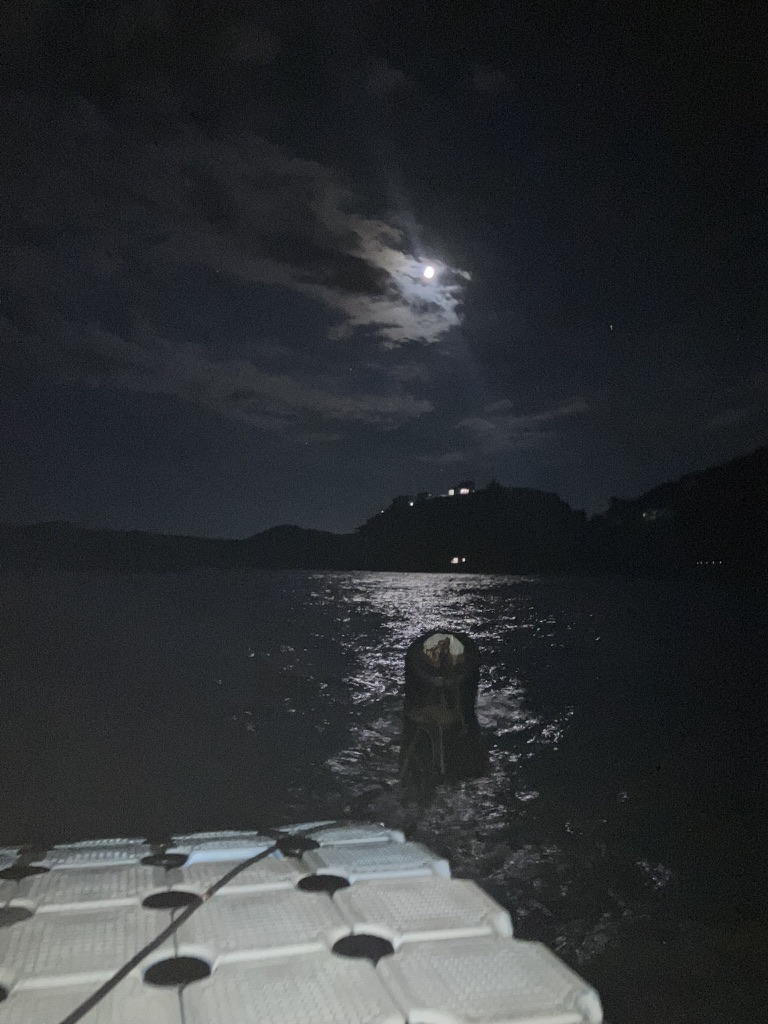
In early October, I started waking up and jumping into the slightly cold ocean to clear my mind. During the day, I often sat on the pier, sunbathing and meditating. As the month went on, going outside half-dressed gradually became colder, and I expect that October 26th will be my last swim of the season. (Although I might still swim in November if I feel like chasing the cold.)
サイレントベースの塗装のアップデート
In my July blog entry, I wrote about how I failed the first attempt at refinishing my Silent Bass.
Because I used an acrylic-based oil paint, the coating became too thick, and the instrument stopped resonating completely. It wasn’t enjoyable to play, and my practice time dropped. This time, I sanded off the old finish, stained it with Trans Black Dye, and finished it with Tru-Oil.
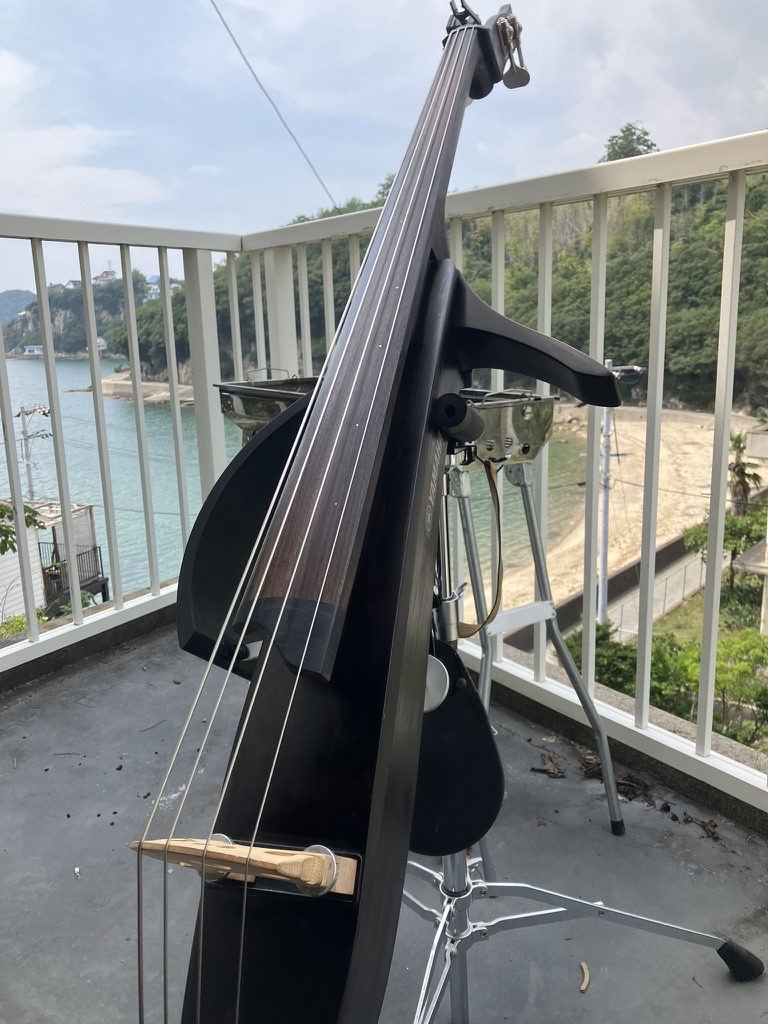
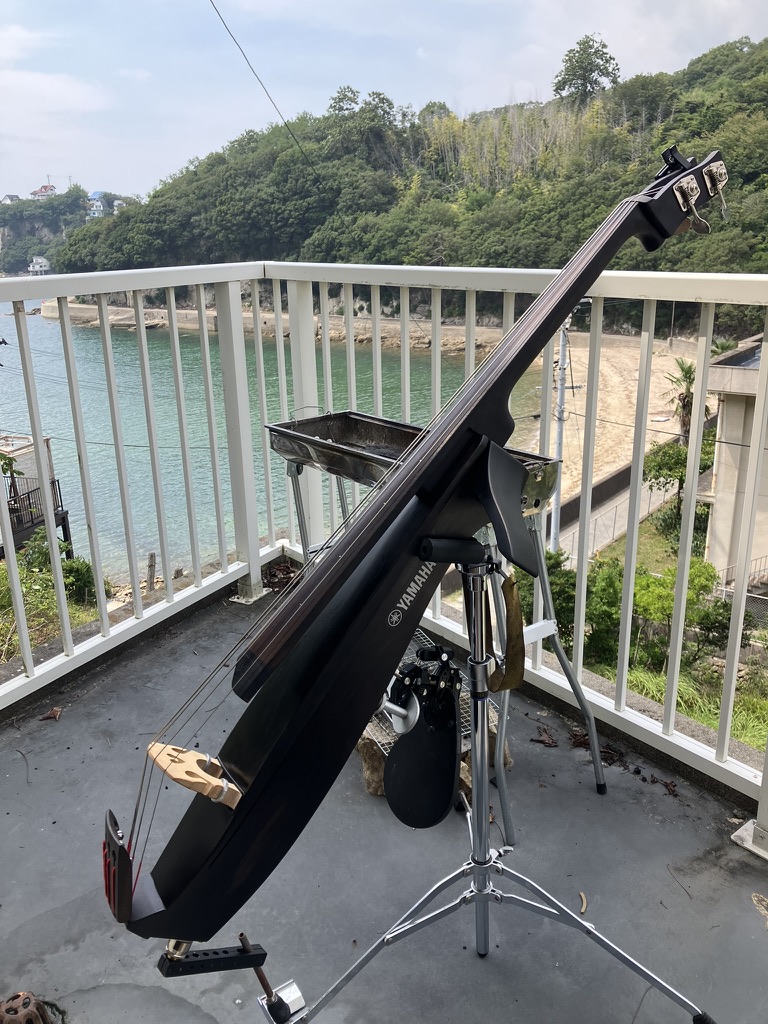
Both materials were somewhat expensive, but after playing it post-refinish, I could immediately hear a significant difference in the sound. The sustain is completely different. I think the instrument now resonates even better than when I purchased it from Kurosawa Gakki. It became clear that these two finishes create a very thin coat and do not interfere with the resonance of the wood.
It’s still strange to me that the finish of an instrument can affect the sound this much.